


In Western singing, voice types are grouped by three things: your range (lowest to highest usable notes), your tessitura (the zone that feels and sounds best), and your timbre (tone color). The six standard types are Soprano, Mezzo‑soprano, Contralto, Tenor, Baritone, and Bass. These categories overlap—your “type” can evolve with training, age, and style.
Quick list of the 6 types:
Soprano
Mezzo‑soprano
Contralto (Alto)
Countertenor
Tenor
Baritone
Bass
Ever wondered whether you’re a soprano, alto, tenor, or bass? Understanding your singing voice type is the first step toward unlocking your full vocal potential. Every singer has a unique vocal range and tone, and knowing which of the main singing voice types you belong to can help you choose the right songs, join the perfect choir section, and train your voice more effectively.
In this guide, we’ll explain the different singing voice types—what they mean, how to identify your own voice type, and why finding your vocal range matters. Whether you’re a beginner trying to figure out where you fit, or an experienced vocalist looking for clarity, this breakdown will help you sing with more confidence and skill.
What “voice type” really means
Registers: chest, head, mix, and falsetto are coordinations you use across the range. Register balance doesn’t change your type, but it changes how easy and resonant the notes feel.
Range: the span of notes you can phonate with control, from your lowest reliable pitch to your highest.
Tessitura: the stretch of notes that feels comfortable and sounds consistent for longer phrases. Your tessitura—not your absolute highs or lows—matters most for classifying type.
Timbre: the tonal “color”—bright, warm, dark, brassy, smoky, etc.
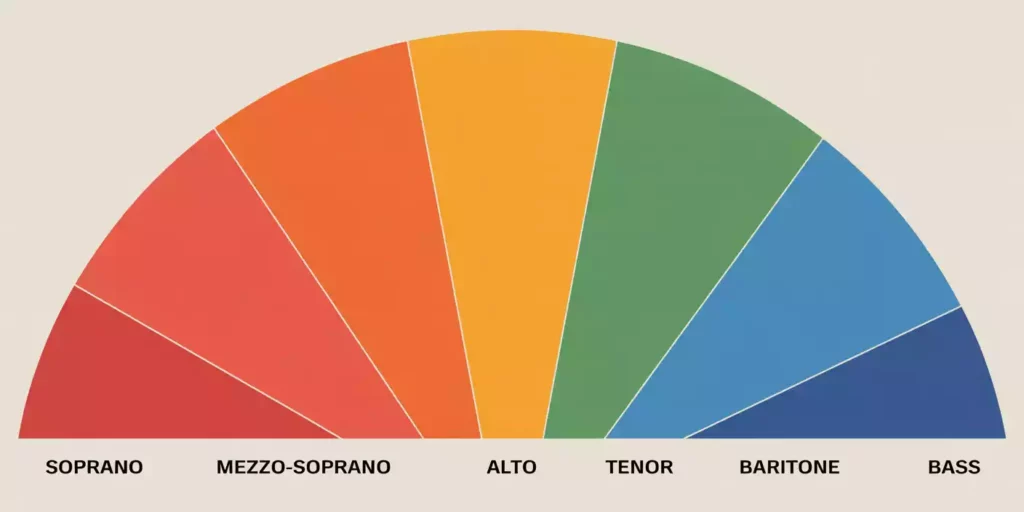
Let’s explore the different voice types
Voice types are broadly categorized based on vocal range, tessitura, and timbre. Here’s a list of the common classical voice types for both male and female singers:
Female Voice Types
Soprano
- Typical written range: C4–C6
- Typical tessitura: G4–G5
- Hallmarks: brilliant/bright upper register, ring in the top octave, agility favored in many styles.
- Common roles/uses: lead melody in choirs, many classical and musical theatre leads, pop top‑lines and harmonies.
- Example artists (varied): Ariana Grande, Renée Fleming, Hayley Williams.
Train the top: see Singing High Notes: 7 Pro Tips and Vocal Techniques, refine vibrato with The Ultimate Guide to Singing Vibrato, and focus tone with Singing Techniques to Improve Your Tone and Resonance.
Mezzo-Soprano
- Typical written range: A3–A5
- Typical tessitura: E4–E5
- Hallmarks: warm middle voice with access to soprano top and alto color.
- Common roles/uses: pop/rock leads, harmonies, musical theatre belt/mix roles.
- Example artists: Beyoncé, Lady Gaga, Adele (many classify as mezzo).
Build mix and range: start with Easy Vocal Exercises for Aspiring Singers, extend upward safely with Singing High Notes: 7 Pro Tips and Vocal Techniques, and strengthen resonance with Singing Techniques to Improve Your Tone and Resonance.
Contralto (often called “Alto” in choirs)
- Typical written range: F3–F5
- Typical tessitura: C4–E4
- Hallmarks: rich, dark timbre, comfortable low and midrange.
- Common roles/uses: lower choral harmonies, soulful/gospel leads, indie/alt textures.
- Example artists: Annie Lennox, Tracy Chapman, Amy Winehouse (contralto color).
Develop low notes and presence: use Tips & Pro Techniques for Singing Lower Notes and shape tone with Singing Techniques to Improve Your Tone and Resonance.
Male Voice Types
Countertenor (distinct male type)
- Typical written range: G3–E5 (varies; significant overlap with alto)
- Typical tessitura: B3–D5
- Hallmarks: light, flexible upper register; many sing primarily in head/falsetto with a blended mix.
- Common roles/uses: early music/baroque, choral alto lines, contemporary indie/pop textures.
- Example artists: Andreas Scholl, Sam Smith (upper mix/falsetto work), Mitch Grassi.
Balance head/mix: see The Ultimate Guide to Singing Vibrato and strengthen coordination with Proper Singing Technique.
Tenor
- Typical written range: C3–C5
- Typical tessitura: A3–A4 (varies by style)
- Hallmarks: bright, ringing upper middle; leads in many genres.
- Common roles/uses: pop/rock leads, musical theatre tenors, choral tenor lines.
- Example artists: Bruno Mars, Freddie Mercury, Ed Sheeran.
Build sustainable top notes: start with Vocal Warmup Exercises for Singers, then Singing High Notes: 7 Pro Tips and Vocal Techniques.
Baritone
- Typical written range: G2–G4
- Typical tessitura: C3–E4
- Hallmarks: robust, full midrange; sits between tenor brightness and bass depth.
- Common roles/uses: singer‑songwriter leads, rock, R&B baritones, many theatre roles.
- Example artists: John Legend, Michael Bublé, Chris Stapleton.
Expand flexibility across the middle: Improve Your Vocal Technique & Sing Better, Singing Techniques to Improve Your Tone and Resonance.
Bass
- Typical written range: E2–E4
- Typical tessitura: A2–C4
- Hallmarks: depth and weight in the low register; authority in resonance.
- Common roles/uses: bass lines in choirs and a cappella, low harmony features, country/gospel leads.
- Example artists: Avi Kaplan, Johnny Cash, Josh Turner.
Strengthen lows without strain: Tips & Pro Techniques for Singing Lower Notes and support fundamentals with Proper Singing Technique.
Unsure of your vocal range? It’s easy to find your vocal range at home with your phone, iPad, or computer.
Choral vs. Solo vs. Contemporary
Choral voice parts (SATB) are seat assignments that balance the ensemble. Solo/classical systems (like Fach) consider range, tessitura, timbre, and agility. Contemporary styles (pop, R&B, musical theatre) add tools like mix and belt—these don’t change your type, but they change how and where you sing comfortably. It’s normal to sing different parts in different contexts.
Voice Types vs Techniques
Understanding the distinction between voice types and voice techniques is crucial for vocalists as they develop their skills and explore their vocal identity.
Voice types refer to the categorization of a singer’s voice based on physiological characteristics such as vocal range, tessitura (the most comfortable singing range), timbre (quality or color of the voice), and vocal weight. These categorizations help singers identify the types of repertoire and roles best suited to their natural vocal attributes.
Common Classifications:
Female: Soprano, Mezzo-Soprano, Contralto
Male: Tenor, Baritone, Bass
Special: Countertenor, which is a male voice singing in the female contralto range
Purpose of Voice Type Classification
- Helps in selecting suitable repertoire and roles within a given genre, especially in classical music and opera.
- Guides vocal development and technique focus specific to the needs of that particular voice type.
How to find your voice type safely (at home)
- Warm up first. 5–10 minutes of gentle slides and sirens. Try Vocal Warmup Exercises for Singers or Easy Vocal Exercises for Aspiring Singers.
- Map your current range. Using a keyboard app or our Vocal Range test tool, slide down to your lowest clear note, then up to your highest controlled note. Follow our guide: How to Find Your Vocal Range at Home or Anywhere.
- Notice your easy middle (tessitura). Where could you sing a whole song without fatigue? That “home base” matters more than your highest brag note.
- Compare to the typical ranges above. Choose the category that best fits both range and tessitura—expect overlap.
- Reassess over time. Your voice adapts with training, style, health, and age. Take our quick checkup: Voice Type Test: Understanding Your Vocal Identity or try tools: Voice Type Apps & Tools to Find Your Vocal Range.
Voice Techniques
Voice techniques are the methods and skills singers use to achieve particular vocal effects and expressions, regardless of their natural voice type. Techniques are tools and skills learned and developed through practice.
- Allows singers to adapt their natural voice to different genres and styles.
- Enhances emotional expression and versatility within performances.
- Assists in overcoming technical challenges related to specific pieces of music.
Learn more about Vocal Technique for Singers and how it can help you improve your singing
Exploring Different Voice Techniques
Falsetto
Often used by singers, particularly men, to reach notes higher than their modal voice range, similar to the range of a countertenor or even soprano. Widely used in pop, R&B, and choral music.
Falsetto requires a gentle approach to breath support, ensuring a smooth transition from the chest voice to avoid breaks.
Raspy Voice
This technique involves a rough, gritty quality to the voice that can add emotional intensity or edge to a performance.
Commonly found in rock, blues, and pop genres. Singers like Janis Joplin and Rod Stewart are known for this style. Use caution with this technique to avoid vocal strain. Engage in proper vocal warm-ups and do not push the voice past its limits.
Learn more about Raspy Voice singing →
Smokey Voice
Characterized by a smooth, husky texture, producing a sultry and intimate sound. Popular in jazz and soul genres. Singers like Norah Jones and Amy Winehouse use this voice technique effectively.
Achieve this by relaxing the throat and slightly under-supporting the voice to create a velvety sound.
Learn more about Smokey Voice singing →
Gritty Voice
A gritty voice isn’t a formal voice type like “alto” or “tenor,” but rather a special quality that can be heard across many singing ranges. Grit can exist in high and low voices, male or female, and in every style from blues to country to modern indie. What sets a gritty voice apart is its textured, emotionally-charged edge—an unmistakable roughness that gives every phrase extra punch and presence.
Interested in what makes a voice sound gritty, and which artists are known for this unforgettable vocal style? Explore our in-depth guide on Singers with Gritty Voices to discover examples, tips, and how grit can make any voice truly legendary.
Vibrato
A slight variation in pitch that adds warmth and richness to the tone.
Employed across various musical genres including opera, jazz, and pop.
Achieved through controlled, rapid oscillation of pitch, often requiring practice to coordinate breath control and laryngeal movement.
Learn more about singing Vibrato →
Belting
A powerful singing technique using the chest voice to project strong, full tones in high registers.
Common in musical theatre and popular music.
Engage strong breath support and maintain open throat posture. Work with a vocal coach to prevent strain.
Learn more about Belting Safely and What All Singers Should Know About Belt
Yodeling
Rapid change between the chest and head voice, creating a unique, “breaking” sound effect.
Essential in folk and country music.
Requires practice to coordinate quick shifts between registers without tension.
Scat Singing
Improvisational singing using non-lexical syllables, sounds, or nonsense words, often used in jazz.
Known as a quintessential element of jazz improvisation.
Focus on rhythmic articulation and inventiveness, mimicking the style and phrasing of instruments.
Vocal Scooping
In general, vocal scooping is a technique that involves approaching a sung note by gliding up to it from below the intended pitch, often creating a smooth, emotive transition into the note. This technique adds expression and nuance to vocal delivery and is commonly used in contemporary genres like pop, jazz, and R&B.
Emotional Expression: Scooping is often used to convey emotion, providing a sense of yearning or longing, and can make a performance feel more personal and intimate.
Start Below the Pitch: Begin slightly below the intended pitch, then glide smoothly and steadily upward to the target note. It’s important to maintain a consistent tone quality throughout the scoop.
Learn more about Vocal Scooping →
Overtone Singing
Producing multiple pitches simultaneously by manipulating the resonance of the voice.
Found in traditional music of Mongolia and Tuva, as well as in some Western experimental music.
Mastery involves controlling the shape of the mouth and throat to isolate overtones.
When experimenting with these techniques, it’s crucial to maintain proper vocal health through regular warm-ups, hydration, and working with a vocal coach to ensure you use these styles safely and effectively. Each technique adds a unique flavor and emotional depth to performances, enriching the singer’s expressive capabilities.
Relationship Between Voice Types and Techniques
Natural Voice Type as a Foundation
A singer’s voice type provides the fundamental framework within which techniques are applied. For instance, a soprano might use vibrato to enrich her natural high timbre, while a baritone might explore belting in musical theatre to extend his usable range and dynamics.
Techniques as Adaptation Tools
Techniques allow singers to stretch beyond the limitations of their natural voice type. For example, a tenor might use falsetto to achieve notes typically outside his range in standard modal voice.
Mastery and Versatility
While a singer’s natural voice type does guide repertoire choices, mastering different techniques allows greater versatility and the ability to perform a wider range of music.
Cross-Genre Adaptability
Techniques play a crucial role in enabling singers to cross genres. A classically trained soprano could use pop techniques like belting to perform musical theatre, showcasing flexibility beyond traditional expectations.
Voice Types vs Voice Ranges
Understanding the difference between voice types and voice ranges is essential for all singers.
Voice Types
Definition: Voice types categorize singers based on their natural vocal characteristics, such as timbre, tessitura, and vocal weight, rather than just their ability to hit certain notes.
Why we use Voice Types:
- Voice types provide a framework for understanding which roles and pieces a singer may be most suited for.
- Offers guidance for vocal training and development, as each voice type presents unique opportunities and challenges.
Examples:
- Female voice types include Soprano, Mezzo-Soprano, and Contralto.
- Male voice types include Tenor, Baritone, and Bass.
Voice Ranges
Definition: Voice range refers to the span of notes a singer can physically reach, from their lowest to highest pitches. It’s a measure of the extent of notes a voice can produce, without implying the comfort or quality in that range.
Why we use Voice Ranges:
- Helps determine the specific notes a singer can comfortably sing, important for choosing individual parts and songs that fit well within a singer’s capabilities.
- Useful for choir or ensemble directors when placing singers in sections suited to their vocal range.
Examples:
- A soprano’s range generally spans from C4 to C6, while a bass’s range might span from E2 to E4.
Choosing songs that fit your voice
Match songs to your tessitura first. Start with keys that put verses in your comfy zone and choruses near, not above, your top.
Use our curation and expert advice:
How to Choose the Right Song for Your Voice: From the Experts
Easy Songs To Sing
Auditioning? See Top American Idol Audition Songs, 10 Tips to Nail Your American Idol Audition From Coaches and Contestants, and How to Audition for American Idol: Step‑by‑Step Guide.
Soprano, Mezzo‑soprano, Contralto, Countertenor, Tenor, Baritone, and Bass. In choirs, “alto” often means the lower female/treble line and may include mezzos and contraltos.
True contraltos and true basses are comparatively rare; countertenors are less common in general populations but prominent in specific styles. Remember: rarity isn’t a value judgment.
You can expand range, smooth register transitions, and shift tessitura comfort. Training won’t turn a bass into a tenor, but it can help you sing higher or lower more easily within your natural instrument. Start with Improve Your Vocal Technique & Sing Better.
Range is your absolute span of notes. Tessitura is where your voice sounds/feels best for sustained singing. Choose songs for tessitura first.
Check where melodies sit comfortably. If your sweet spot is lower and you prefer darker timbre, you may lean contralto/alto; if you’re comfortable a bit higher with warmth through the middle, you may lean mezzo. Verify with How to Find Your Vocal Range and the Voice Type Test: Understanding Your Vocal Identity.
A countertenor is a male singer who specializes in alto‑range repertoire, often using a developed head/falsetto blend. It’s a distinct male type, not a tenor subtype.
Hydration, sleep, hormones, stress, and warming up all affect how high/low you can sing. See What singers drink for their voices: drinks for your singing voice and How to Practice Singing at Home for consistency tips.
Next steps and recommended reading
- Technique fundamentals: Proper Singing Technique
- Warm up and daily maintenance: Vocal Warmup Exercises for Singers
- Extend range safely: 5 Secrets to Increasing Your Vocal Range and Power
- Confidence and performance: Stage Fright: Professional Tips for Overcoming Stage Fright for Emerging Artists
Ready to Make the Most of Your Unique Voice Type?
Now that you understand the different voice types, why not put that knowledge into action? Whether you’re a soprano, alto, tenor, baritone, or bass, every voice has its own beauty, potential, and possibilities!
Here’s how you can keep exploring and growing as a singer:
- Find Songs That Fit Your Voice: Discover our curated list of Easy Songs to Sing for every voice type—perfect for building your confidence and enjoying your practice.
- Learn Your Exact Vocal Range: Follow our step-by-step guide, How to Find Your Vocal Range at Home, and gain clarity about where your voice shines.
- Explore Your Potential With a Vocal Coach: Interested in personalized feedback and supportive guidance? Our online voice lessons bring expert coaching to you, wherever you are—perfect for unlocking your unique sound.
Remember: Every voice is unique. The most important thing is to embrace your natural sound and enjoy the adventure of singing!
Take your next step—your musical journey is just beginning.